 Uniswap
 Connects Token Swaps, Pooled Liquidity and Onchain Verification
Uniswap is a suite of onchain protocols that lets a wallet swap tokens or supply liquidity through smart contracts rather than a custodial order book. A swap changes pooled balances under a version-specific market-making design, while liquidity providers take exposure to those balances in exchange for a share of pool fees. Every committed action leaves a transaction record on the selected network.
Table of contents
Before wallet authorization, treat the quote as a proposal rather than final settlement. Check the token contracts, network, proposed route, approval scope and minimum output, then compare the receipt and confirmed balance changes with those terms after execution.
The short version: Treat a Uniswap swap as complete after the selected network records success and the expected token balance appears.
Swap Review From Quote to Receipt
The normal swap path moves from token selection to quote review, wallet authorization and confirmed settlement. Until the wallet submits the transaction, the route remains a proposal that can be changed or abandoned without executing the swap.
Token selection should establish the network and both contract addresses because unrelated assets can share a symbol. A useful quote identifies the expected output, route, pool fee, price impact, maximum slippage and network cost when those fields apply. An ERC-20 token may also require an approval before or alongside the swap. That approval grants spending permission without transferring ownership by itself.
The decision before commitment rests on five checks.
- Match the network and token contracts to the intended assets.
- Compare the expected output with the minimum acceptable output.
- Read the proposed route, pool fees and network cost.
- Confirm that any approval names the intended token and spender.
- Keep enough of the network asset available for transaction costs.
If the quote changes before submission, request a fresh quote instead of trying to use the previous route. If a transaction remains pending, its network status should be checked before another attempt is sent. A reverted call does not settle the proposed pool changes, although it can still consume network fees. A successful receipt, matching transfers and the expected wallet balance provide completion evidence.
Pools, Routes and Balance Changes
Pool mechanics connect a trader’s requested exchange with assets supplied by liquidity providers. Smart contracts calculate the state change, enforce the relevant invariant and reject execution when the submitted conditions no longer hold.
Pool State
In Uniswap v2, pool state records the reserves and pricing relationship of two assets. Uniswap v2 uses the constant-product relationship x times y equals k, with the swap fee applied to the input when the contract checks the invariant. Removing one asset through a swap adds the other and changes their relative pool price. Larger trades generally move that price further when available liquidity is shallow.
Route Construction
Route construction can use one pool, several sequential pools or a split across available liquidity sources. A router may compare expected output against network cost, slippage and available liquidity before proposing a path. Each additional hop introduces another pool state that can change before confirmation. The displayed route is therefore an executable proposal based on a particular observation, not a reserved exchange rate.
What Determines the Amount a Swap Delivers?
Swap output comes from pool state, the chosen route, swap fees and execution conditions when the transaction reaches the chain. Network cost is paid separately in the network’s native asset, so it should not be folded into the token output.
Price Impact
Price impact is the price movement caused by the swap itself. It grows with order size relative to usable liquidity along the route. Deep liquidity can absorb the same input with less movement, while a shallow pool may produce a sharply lower output. Price impact already appears in the quoted economics and is distinct from later market movement.
Pool and Protocol Fees
Swap fees accrue to active liquidity providers under the selected pool’s rules, although an enabled protocol fee directs part of the swap fee to the protocol. Fee structure and distribution differ among protocol versions, pool configurations and hook-enabled v4 pools. A route that crosses multiple pools can encounter more than one fee calculation. Exact values should come from the proposed route because there is no single rate that describes every Uniswap swap.
Network Cost and Slippage Limits
Network cost pays for blockchain execution and usually uses the selected network’s native asset. Slippage measures the difference between the expected execution and the result available when the transaction runs. A maximum-slippage setting establishes a failure boundary: execution can proceed within that limit or revert outside it. Raising the limit permits a wider outcome and does not improve the pool price.
Protocol Versions and Their Trade-Offs
Protocol versions remain distinct deployments with different liquidity accounting, position management and extension models. A version choice changes how providers allocate capital and how integrations interact with pools, even when the intended token exchange looks similar.
Uniswap v2
Uniswap v2 uses full-range constant-product pools and represents a provider’s proportional share with fungible ERC-20 liquidity tokens. Capital supports prices across the entire curve. This design is comparatively direct to inspect, but it cannot concentrate liquidity around a narrower trading range.
Uniswap v3
Uniswap v3 introduced concentrated liquidity, allowing a provider to place liquidity within a chosen price range. The standard position manager represents positions with distinct ranges and pool settings as non-fungible tokens. Concentration can use capital more efficiently while the market remains in range, but the position needs monitoring because it stops earning swap fees when the price moves outside that range.
Uniswap v4
Uniswap v4 manages pools through a singleton PoolManager and retains concentrated liquidity. Flash accounting tracks net balance changes during a call and requires those deltas to settle before completion. Hooks can add fee logic or other pool behavior at defined points in the lifecycle. That flexibility makes a pool’s hook code and configuration part of the decision, rather than an interchangeable detail.
Liquidity Provision and Range Management
Liquidity provision turns two assets into an active market-making position whose composition changes as traders use the pool. The provider may collect pool fees, but those fees do not guarantee that the position will outperform simply holding the deposited assets.
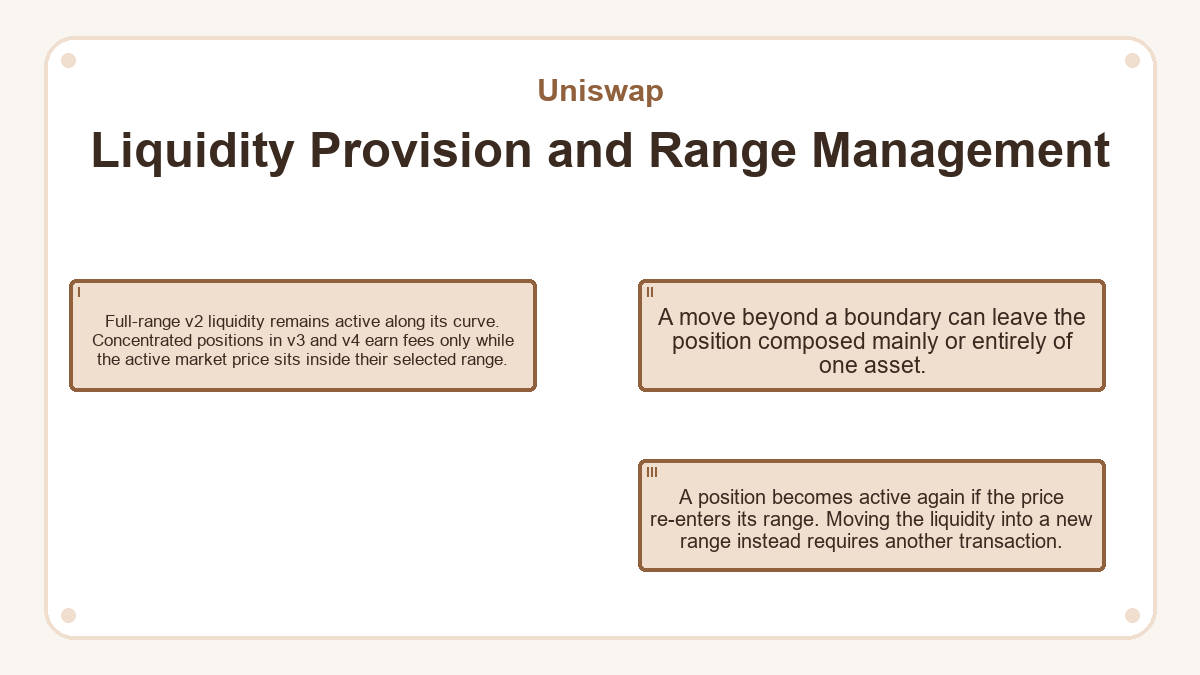
Full-range v2 liquidity remains active along its curve. Concentrated positions in v3 and v4 earn fees only while the active market price sits inside their selected range. A move beyond a boundary can leave the position composed mainly or entirely of one asset. A position becomes active again if the price re-enters its range. Moving the liquidity into a new range instead requires another transaction.
Withdrawal returns assets according to the position and current pool state, not necessarily the original deposited quantities. The practical comparison therefore includes fee income, network costs, price exposure and any hook-specific behavior. Together, those factors determine the position’s net result.
Token Identity and Contract Permission
Token identity begins with the blockchain and contract address. Identical names, symbols or visual assets can belong to unrelated contracts, and permissionless pool creation does not authenticate the asset placed in a pool. The intended input and output contracts should remain consistent from selection through the wallet’s signing request.
Contract permission matters separately from token identity. An allowance authorizes a named spender to move up to its permitted amount under the token contract’s rules. It can remain active after a swap unless it is limited, spent or revoked. Before signing, verify the spender and allowance scope so the routing contract does not receive broader permission than the action requires.
Onchain Verification After Submission
Onchain verification starts with the transaction receipt rather than the existence of a transaction hash. The receipt shows whether execution succeeded or reverted, while its logs record token transfers and other contract events. Wallet balances should then reflect the expected input spent and output received. A pending hash proves only that an attempt was submitted.
Liquidity actions leave different evidence. A provider can check position ownership, recorded liquidity and any collected or uncollected fees through the relevant contracts. Approval state should also be reviewed independently because a successful swap or deposit does not necessarily remove the remaining allowance. A mismatch among receipt status, event logs and balances needs reconciliation before another transaction is attempted.
Governance, Interfaces and Protocol Boundaries
Protocol boundaries separate core automated market maker contracts from routers, position managers, wallets and user interfaces. Core versions are deployed as distinct contracts rather than replacing earlier pools in place. UNI holders participate in protocol governance, but governance does not approve individual swaps. Custom routers and v4 hooks can add behavior beyond the core pool, so their addresses, permissions and execution rules form part of the transaction being authorized.
Choosing the Next Onchain Action
Path selection starts with the intended state change. A swap seeks a defined output from an input token, while liquidity provision accepts changing asset composition to earn pool fees. A contract integration adds another dependency: it must target the correct deployment and handle approvals, settlement and reverts according to that version.
Each path also has different completion proof. A swap ends with a successful receipt and matching balances. A liquidity action ends with a recorded position or updated liquidity state. An integration must additionally reconcile its internal accounting with token transfers and any balance deltas returned by the relevant protocol contracts.
Before submission, leaving the flow preserves the prior onchain state. After confirmation, reversing economic exposure requires a new transaction rather than editing the old receipt. Removing liquidity also executes against the pool’s current state and may not restore the original token quantities. The next decision is whether to hold the received asset, maintain a position or stop after settlement.
Worth knowing
Does Uniswap Take Custody of Tokens During Ordinary Swaps?
Ordinary pool swaps are self-custodial: the wallet authorizes a smart contract transaction and the contracts settle it onchain. The protocol does not maintain a conventional trader account balance between swaps. A separate interface, wallet or routing service may add its own transaction flow, so the signed call and approved spender still need review.
How Long Does a Uniswap Swap Take?
A Uniswap swap has no universal completion time. Confirmation depends on the selected network, current demand, submitted network fee and whether the transaction meets its deadline and slippage limit. A displayed deadline limits how long the swap may remain executable; it does not promise that a block will include the transaction within that period.
Is There a Minimum Amount for a Uniswap Swap?
There is no single useful minimum across every Uniswap pool and route. Very small swaps can become impractical when network cost, token behavior or rounding dominates the expected output. The relevant test is whether the route returns a valid quote, the minimum output remains meaningful and the wallet has enough of the network’s native asset for execution.
Do I Need UNI to Pay the Network Cost?
UNI is not generally the gas asset used to submit a Uniswap transaction. Network costs are normally paid with the native asset required by the chosen blockchain, while UNI is the protocol’s governance token. Some interfaces or routes may sponsor or abstract gas under stated conditions, but that feature should be read from the live transaction rather than assumed.
What Controls Whether Liquidity Can Be Withdrawn?
Position ownership and the pool’s contract rules control withdrawal. A standard liquidity position can be reduced or closed by its owner, with returned token amounts determined by the current pool state. A Uniswap v4 pool may use hooks that alter behavior or add conditions, so the hook and position manager involved in the deposit matter before funds are committed.
What Happens After an Incorrect Swap Is Confirmed?
A confirmed swap cannot be edited or reversed by changing the original transaction. Recovering the prior exposure requires a new transaction, such as swapping the received asset back, and that action faces fresh pool fees, price impact and network cost. If value reached an unintended destination, recovery depends on control of that address and any applicable contract behavior.